Indoor plants are often said to make buildings healthier – but what does “healthier” really mean? Cleaner air, better humidity, less stress, or perhaps a more subtle ecological shift in the life of indoor spaces?
In our newly published paper “Ten questions on indoor greening and environmental quality” (pubished in Building and Environment, 2026) we examine how indoor green infrastructure (iGI) affects indoor environmental quality, looking beyond familiar claims about air purification to consider thermal comfort, humidity, HVAC systems, bioaerosols, wellbeing, equity, and implementation in real buildings.
One of my main contributions in the paper focuses on whether indoor green infrastructure can help rewild indoor microbial ecosystems and, in doing so, support human health (Q6).
The question starts from a simple but overlooked fact: we spend most of our lives indoors, yet we know surprisingly little about the ecological life of indoor spaces. Modern buildings are carefully controlled: temperature, humidity, ventilation, light, and cleanliness are all regulated. But by sealing, filtering, disinfecting, and separating interiors from outdoor ecosystems, we may also be creating biologically simplified spaces.
This matters because human health is strongly shaped by the invisible microbial worlds we live with. Reduced exposure to diverse microbial communities has been associated with several immune-related and chronic conditions, although the evidence is still largely correlational. Indoor greening may not prevent disease, but could it help restore some ecological complexity to biologically poor interiors?
Plants are not just decorative objects. Their leaves, roots, soil, and surrounding air host bacteria, fungi, and other microorganisms. Indoors, they may act as small microbial hubs, creating points of exchange between soil, air, surfaces, and people. This is where indoor rewilding becomes interesting: not simply adding greenery, but making interiors more ecologically connected, more diverse, and less dominated by a narrow range of human-associated microbes.
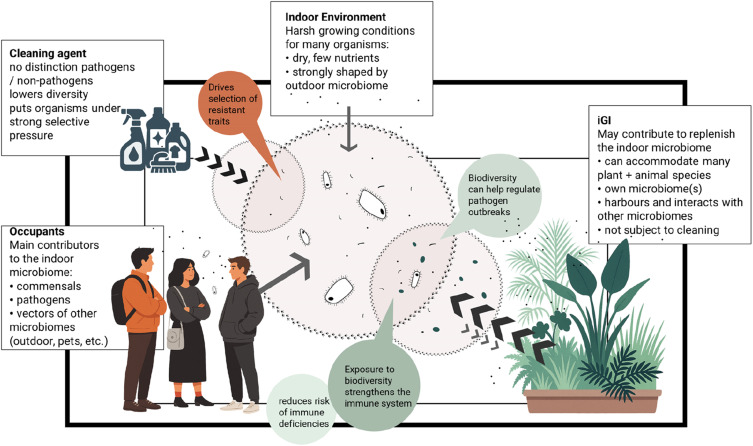
Living plants as potential mediators of microbial diversity in indoor spaces.
What makes this question especially important is its shift in perspective: indoor greening is not simply about adding plants as isolated “tools”, but about rethinking the relationships between human, plant, and environmental health. For architects and designers, this means that indoor greening should not be reduced to wellness branding or aesthetic biophilia. If we introduce life into buildings, we also take responsibility for its long-term care and ecological behaviour.
While the evidence is still emerging, creating healthier interiors may require us to move beyond the idea of buildings as sealed machines and begin to understand them as ecological networks.
One Comment