We often hear that having plants indoors makes us healthier, happier, and more productive — but how much of that is actually backed by science? In my review “Benefits of Using Plants in Indoor Environments: Exploring Common Research Gaps” (published in Architecture, 2021), I took a close look at what the research really shows about plants inside buildings. I reviewed 31 studies and found that researchers use a wide mix of parameters and metrics to assess plant effects, but without much alignment or consistency between them. Spoiler: the results are far from consistent.
Many studies claim that plants clean the air, regulate indoor climate, or even reduce stress. But when you dig deeper, you find that a lot of experiments are done in sealed chambers, not in the kinds of spaces we actually live and work in. Important information like what species were used, the plant maturity, how many plants were tested, or what conditions the plants grew in are often missing. Without that kind of information, it’s hard to compare results – and even harder to draw solid conclusions about what really works.
What’s missing, I argue, is a shift in how we frame the whole topic. Instead of treating plants as decorative “tools” to fix indoor problems, we should think of interiors as living ecosystems where people, materials, microbes, and plants all interact. To really understand the benefits of indoor greenery, we need better experiments, clearer reporting, and studies that reflect real-world settings. Most of all, we need to shift away from our human-centered mindset and start considering plant health and human health together. Only by looking at them as part of the same system can we begin to understand how green design might truly transform the spaces we live and work in.
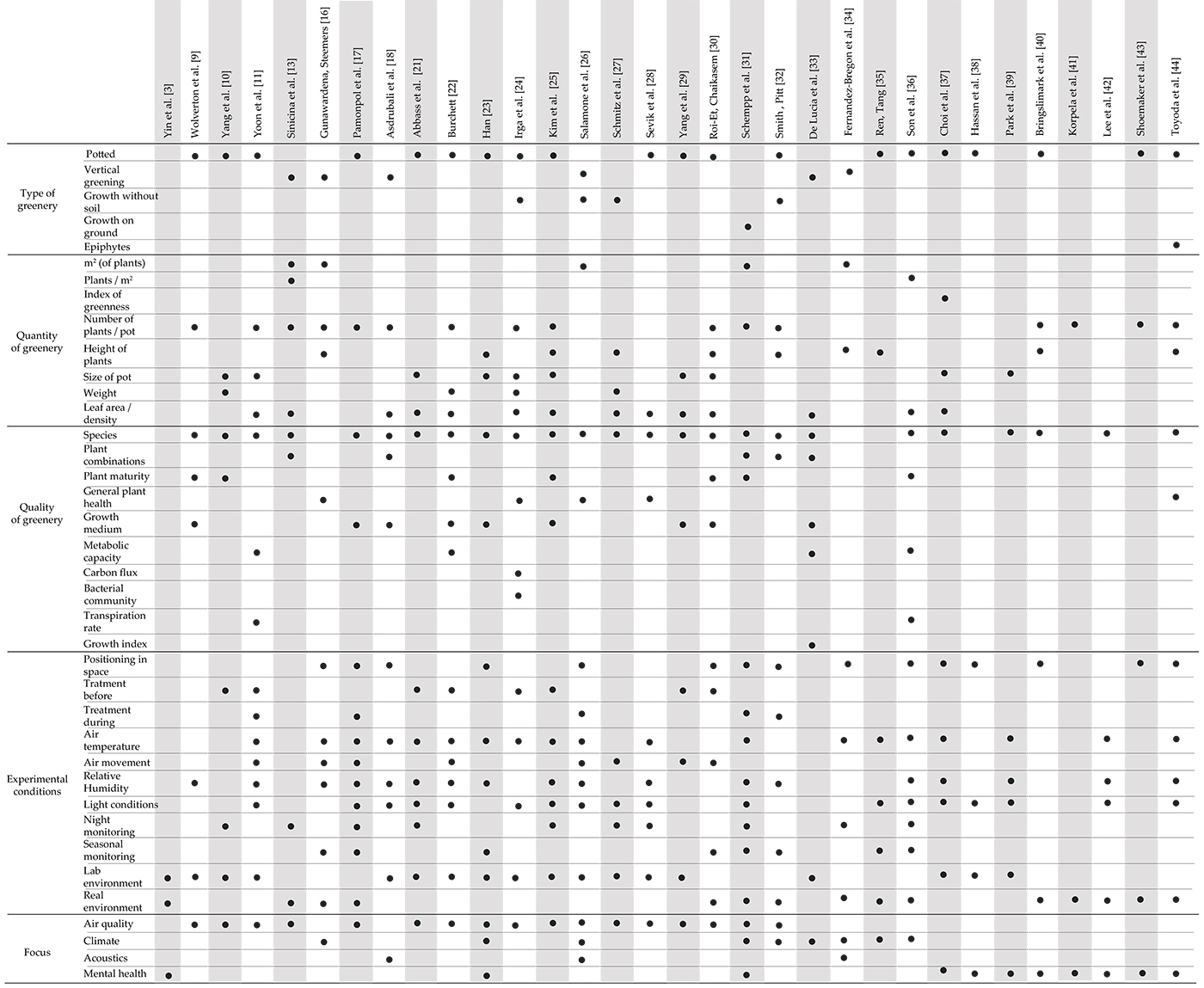
Above, summary of the plant-related parameters studied in the literature reviewed
Based on:
Persiani, S. G. L. (2021) – Benefits of Using Plants in Indoor Environments: Exploring Common Research Gaps. Architecture, 1(2), 83–98. DOI: 10.3390/architecture1020008